

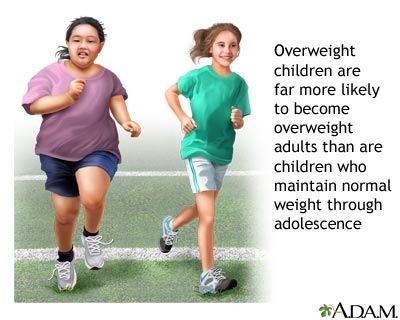
Childhood obesity has become an epidemic in America. According to the Centers for Disease Control and Prevention (CDC), more than one third of children and adolescents are overweight or obese.
How is this defined? These terms are based on the Body Mass Index (BMI) which is a calculation giving a standardized number for comparing a person’s weight to height. This number is then plotted on a growth chart to give a percentile for each child which compares to other children in their age group. Overweight is defined by having a BMI greater than the 85th percentile but less than the 95th percentile. Obesity is defined as having a BMI greater than the 95th percentile.
I’m sure by now you have seen the reports on television and read the newspaper articles regarding this major issue. The state of Georgia ran a series of controversial commercials in a campaign to fight childhood obesity. This method put a face and name on this epidemic to highlight a very serious message.
Long gone are the days of forcing your child to clean his plate. Focus has now been moreso placed on getting children to become more active and educating parents and children on making healthy food choices. I was an obese child, mostly due to poor food choices. I was active, participated in several sports and after school activities. However, my family consumed a large amount of fast food, hamburgers, fries, and fried chicken in various forms was the majority of my diet. At the age of 15, I made the decision to stop eating red meat (beef/pork), to improve my health. And, I haven’t eaten any since! I’m not saying this to offer that as the solution to childhood obesity, believe me, the solution is much more multifaceted than that. I highlight that fact, to bring about awareness of poor food choices.
-For good health it is recommended that we consume 5 servings of fruits and vegetables daily. I have a few tips I have learned over the years to achieve this.
1. Add fruit to your breakfast. Breakfast is the most important meal of the day because it sets the pace for the type of food choices you will make later in the day. Children who aren’t fed breakfast tend to do poorly in school due to lack of ability to concentrate due to hunger. These children also tend to overeat and/or make poor food choices later in the day due to sheer hunger.
2. Lunch should consist of a vegetable and a fruit. Yes, now we’re up to 3 servings already! Kids like things that are multicolored and fun to eat. Try making veggies and fruit into shapes and use things that are different colors and textures for fun!
3. Fruit makes an excellent after school snack! You can easily keep apple slices, bags of grapes, tangerines, oranges, and strawberries in a ready to eat form at home. Don’t try to substitute processed fruit snacks or juice for fresh fruit. Your child will get much healthier and fuller by eating real fruit!
4. Dinner should always include at least 1 vegetable, preferably 2. And now we’ve got our 5 servings (maybe even 6)!
5. One bonus tip for parents of very picky eaters: try fresh fruit and veggie smoothies. You can easily pack in several different types of fruits and veggies into a smoothie that even picky eaters will be sure to get their needed nutrition. Buy fresh frozen, it doesn’t spoil as fast and you don’t have to add ice because it’s already frozen.
-Make being active a family priority!
Our first lady, Michelle Obama, has spearheaded the “Let’s Move” Campaign to combat childhood obesity by having kids exert more energy by being more active.
“Let’s Move! is a comprehensive initiative, launched by the First Lady, dedicated to solving the problem of obesity within a generation so that kids born today will grow up healthier and able to pursue their dreams.”
By making an active lifestyle a family priority, children will feel like this is the norm. Go on a family hike, ride bikes together, join a family aerobics class (I.e. Zumba), make a family softball or basketball team, join family league bowling, and the list goes on and on.
-Teach your children what it means to make good food choices. Let them help you pick out groceries from the store. Allow them to choose 1 fruit or 1 vegetable of their liking. Let them help you to prepare healthy meals at home. Even something as simple as pressing the button on the blender or adding the carrots at smoothie time (both of which my toddler enjoys doing) allows them to participate in making good food choices.
Let’s face it! Our children are being afflicted with previously thought “adult illnesses” at alarming rates and now it’s time for us to become shining examples and save their lives while they’re young. Healthy choices aren’t always easy choices but they are worth the effort!
What are some things that your family does to promote a healthy lifestyle?
Resources:
Centers for Disease Control and Prevention
Strong4Life
American Academy of Pediatrics
Let’s Move Campaign
The Weight of the Nation
Mercy
Eat Right


 Doctor Mom on the Run